
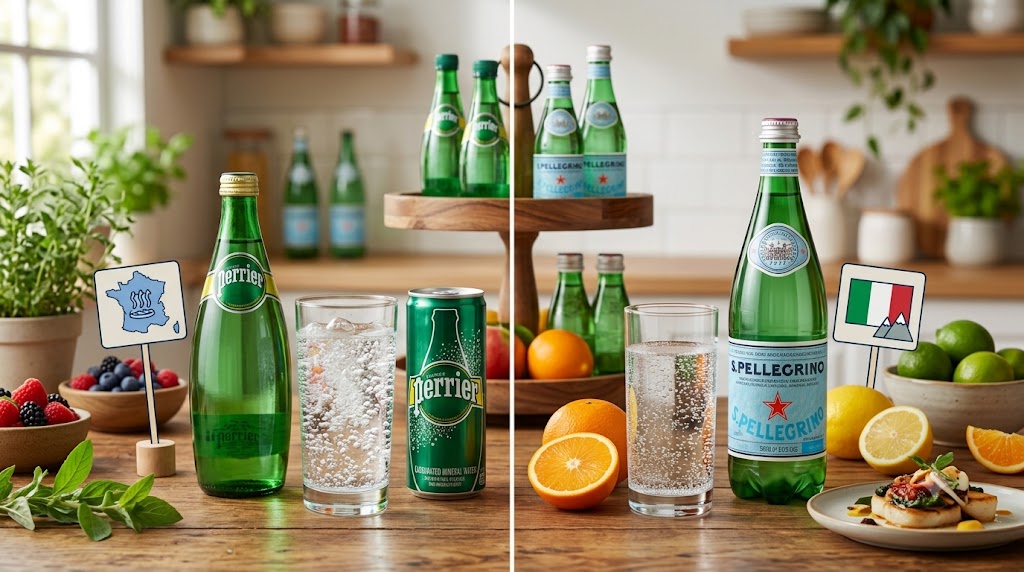
🟢 Perrier vs San Pellegrino Matcher
Answer 2 quick questions to find your perfect European mineral water match!
1. What kind of carbonation/bubble mouthfeel do you prefer?
Order a sparkling water at a nice restaurant in the U.S., and you will almost certainly be asked: “Perrier or Pellegrino?” They are the two most recognized sparkling mineral water brands in the world, both have been around for over a century, and both sit in green glass bottles that signal “premium” from across the room. But crack open one of each and taste them back to back, and the differences are clear.
Perrier vs San Pellegrino is a comparison between two sparkling mineral waters from different European springs with different mineral profiles and very different carbonation styles. Perrier (from Vergeze, France) has aggressive, bold carbonation and a lighter mineral taste. San Pellegrino (from San Pellegrino Terme, Italy) has finer, gentler bubbles and a richer, more mineral-forward flavor. Both are zero calories with no added ingredients.
These are not seltzers. They are not flavored waters. They are natural mineral waters with minerals that come from underground rock formations, not from a factory. That distinction matters if you care about what is actually in your glass. U.S. bottled water retail sales reached $51.3 billion in 2025, according to the International Bottled Water Association, and premium mineral waters like Perrier and San Pellegrino occupy the top shelf of that market. This is the full honest comparison, published here on sparklingwaterflavors.com by the Sparkling Water Flavors Team.
What Is Perrier?
Perrier is a sparkling natural mineral water sourced from the Vergeze spring in southern France. The spring has been in use since at least Roman times, and the modern brand has been commercially bottled since 1898. Perrier was acquired by Nestle in 1992 and is now part of the Nestle Waters portfolio.
The water naturally contains carbon dioxide and minerals, though the gas and water are captured separately at the source and recombined during bottling to ensure consistent carbonation levels in every bottle. The mineral composition includes approximately 150 mg/L of calcium, about 9.5 mg/L of sodium, roughly 3.9 mg/L of magnesium, and about 420 mg/L of bicarbonates. The total dissolved solids (TDS) sit around 475 mg/L.
Perrier offers both an original unflavored mineral water and a line of flavored sparkling waters (including Lime, Pink Grapefruit, Green Apple, and others). Zero calories across all varieties.
What Is San Pellegrino?
San Pellegrino (S.Pellegrino) is a sparkling natural mineral water sourced from three springs near San Pellegrino Terme in the Italian Alps, in the Lombardy region. The springs have been used since at least the 1200s, and commercial bottling began in 1899. San Pellegrino is also owned by Nestle, which acquired it in 1997.
Like Perrier, San Pellegrino captures its naturally occurring carbonation and minerals separately and recombines them during bottling. The mineral profile is richer: approximately 164 to 174 mg/L of calcium, about 49 to 52 mg/L of magnesium, roughly 31 mg/L of sodium, and a higher overall TDS of about 880 to 940 mg/L. That higher mineral content is a major reason San Pellegrino tastes different from Perrier.
San Pellegrino’s core product is unflavored mineral water. The brand also sells a line of Italian sparkling fruit beverages (Aranciata, Limonata, etc.), though those contain sugar and are a separate product category from the mineral water.
Perrier vs San Pellegrino: Full Comparison
| Feature | Perrier | San Pellegrino |
|---|---|---|
| Source | Vergeze, France | San Pellegrino Terme, Italy |
| Bottling since | 1898 | 1899 |
| Owner | Nestle Waters | Nestle Waters |
| Calories | 0 | 0 |
| TDS (mg/L) | ~475 | ~880 to 940 |
| Calcium (mg/L) | ~150 | ~164 to 174 |
| Magnesium (mg/L) | ~3.9 | ~49 to 52 |
| Sodium (mg/L) | ~9.5 | ~31 |
| Carbonation style | Bold, large, sharp bubbles | Fine, gentle, persistent bubbles |
| Taste | Clean, crisp, light mineral | Complex, mineral-forward, smooth |
| Flavored options | Yes (Lime, Grapefruit, etc.) | Mineral water: No. Fruit beverages: Yes (with sugar) |
| Signature format | Green glass bottle (330 mL) | Green glass bottle (750 mL) |
| Price (12-pack cans) | $8 to $12 | $8 to $12 |
| Best for | Bold fizz, solo drinking, mixing | Fine dining, food pairing, sipping |
Mineral Content: What Is Actually in Each Water
This is where the two brands differ most meaningfully. San Pellegrino has roughly double the total dissolved minerals of Perrier. The biggest gaps are in magnesium (San Pellegrino has about 13 times more) and sodium (about 3 times more).
| Mineral | Perrier (mg/L) | San Pellegrino (mg/L) |
|---|---|---|
| Calcium | ~150 | ~164 to 174 |
| Magnesium | ~3.9 | ~49 to 52 |
| Sodium | ~9.5 | ~31 |
| Bicarbonates | ~420 | ~245 |
| Total Dissolved Solids | ~475 | ~880 to 940 |
The calcium levels are similar between the two brands. The magnesium difference is the most dramatic: San Pellegrino’s 49 to 52 mg/L vs. Perrier’s 3.9 mg/L means that drinking a full liter of San Pellegrino provides roughly 12% of the daily recommended magnesium intake, while Perrier provides less than 1%. Neither is a replacement for a magnesium supplement, but the difference is real and measurable.
The sodium difference (31 mg/L vs. 9.5 mg/L) is noticeable on the palate. San Pellegrino’s slightly higher sodium contributes to a fuller, more complex mouthfeel. Perrier’s lower sodium keeps the taste cleaner and crisper. Both amounts are very low compared to any standard dietary threshold.
Carbonation: Bold Fizz vs Gentle Bubbles
This is the other major split. Perrier is known for sharp, energetic carbonation. The bubbles are larger and more aggressive, giving each sip a strong, prickly sensation that hits the tongue fast. It feels lively and assertive. If you like your sparkling water to announce itself, Perrier delivers.
San Pellegrino has finer, smaller bubbles that feel softer and more persistent. The carbonation does not attack the palate; it sits on the tongue and slowly releases, which creates a smoother, more refined drinking experience. The gentle effervescence is one reason San Pellegrino is the default sparkling water at many fine dining restaurants: it complements food rather than competing with it.
The carbonation in both brands is sourced naturally from their respective springs, then recaptured and re-added during bottling to maintain consistency.
Taste: Clean and Crisp vs Complex and Smooth
Perrier tastes clean, bright, and slightly sharp. The lighter mineral profile means the water itself does not carry a heavy mineral taste. What you notice most is the carbonation and a crisp, almost citrusy freshness. It is refreshing in a direct, straightforward way. Perrier works well as a standalone drink, as a mixer for cocktails, and as a palate cleanser between courses.
San Pellegrino tastes rounder, more complex, and more mineral-forward. You can sense the magnesium and sodium on the palate, giving the water a structured, almost savory quality. It reads as “earthy” and “sophisticated” to people who enjoy mineral waters, and “salty” to people who prefer cleaner-tasting water. San Pellegrino is the better food companion, especially with Italian, French, and Mediterranean cuisine, where the mineral character complements rich, savory dishes.
If you handed both to someone blind, most tasters would say Perrier is “fizzier and cleaner” and San Pellegrino is “smoother and more complex.” Neither description is a criticism; they are simply different approaches to what mineral water should taste like.
Price: Premium Shelf, Similar Cost
Perrier and San Pellegrino sit at the same price tier at most U.S. retailers. A 12-pack of cans typically costs $8 to $12 for either brand, depending on the retailer and any active promotions. Individual glass bottles at restaurants range from $2 to $4.
| Product | Format | Typical Price |
|---|---|---|
| Perrier (cans) | 12-pack / 8.45 oz | $8 to $12 |
| Perrier (glass) | Single / 330 mL | $2 to $3 |
| San Pellegrino (cans) | 12-pack / 11.15 oz | $8 to $12 |
| San Pellegrino (glass) | Single / 750 mL | $2.50 to $4 |
Both are more expensive per ounce than mass-market seltzers like LaCroix and bubly, which reflects their premium mineral water positioning and European sourcing.
Nutrition: Is One Healthier?
Both Perrier and San Pellegrino are zero-calorie, zero-sugar beverages with naturally occurring minerals. The Harvard T.H. Chan School of Public Health confirms that sparkling water counts toward daily hydration, and research shows that plain carbonated water is minimally erosive to tooth enamel.
San Pellegrino’s higher magnesium content (roughly 50 mg/L) provides a small but real dietary contribution. The recommended daily intake of magnesium for adults is 310 to 420 mg, per the National Institutes of Health. Drinking one liter of San Pellegrino contributes about 50 mg toward that target. Perrier’s magnesium contribution is negligible at 3.9 mg/L.
San Pellegrino has more sodium (about 31 mg/L), but this is a tiny amount. One liter gives you roughly 31 mg of sodium, which is about 1.3% of the recommended daily limit. Perrier’s sodium (9.5 mg/L) is even lower. Neither brand poses a concern for sodium-conscious individuals under normal consumption.
The Dietary Guidelines for Americans, 2025 to 2030, recommend replacing sugar-sweetened beverages with zero-calorie options. Both Perrier and San Pellegrino qualify.
Which One Should You Buy?
Choose Perrier if:
- You want strong, assertive carbonation
- You prefer a clean, crisp taste with minimal mineral character
- You use sparkling water as a cocktail or spirit mixer
- You want flavored sparkling mineral water options (Lime, Grapefruit, etc.)
- You enjoy a sharp, refreshing bite with each sip
Choose San Pellegrino if:
- You prefer fine, gentle bubbles and a smoother mouthfeel
- You enjoy a complex, mineral-forward taste
- You pair sparkling water with food, especially rich or savory meals
- You want higher natural magnesium content
- You appreciate the “fine dining” standard for sparkling water
Both are owned by Nestle, both are zero calories, and both are sourced from natural springs with over a century of bottling history. The choice comes down to whether you want your bubbles aggressive or gentle, and your mineral taste light or rich.
For a more detailed look at either brand’s full product line, check out our guides to San Pellegrino and Perrier on sparklingwaterflavors.com.
Key Takeaways: Perrier vs San Pellegrino
Perrier has aggressive carbonation and a lighter mineral profile (TDS ~475 mg/L). San Pellegrino has finer bubbles and nearly double the mineral content (TDS ~880 to 940 mg/L).
San Pellegrino has about 13 times more magnesium and 3 times more sodium than Perrier, which gives it a richer, more complex taste. Perrier tastes cleaner and crisper.
Both are zero calories, both are natural mineral waters from European springs, and both are owned by Nestle. The choice is about carbonation style and mineral taste preference.
For more sparkling water comparisons and detailed brand guides, keep browsing sparklingwaterflavors.com.
References
- International Bottled Water Association (IBWA), “Bottled Water Market: 2025 Data,” bottledwater.org
- Perrier, “Perrier Origin Story,” perrier.com
- San Pellegrino, “Water Analysis,” sanpellegrino.com
- Dietary Guidelines for Americans, 2025 to 2030, realfood.gov
- National Institutes of Health, Office of Dietary Supplements, “Magnesium Fact Sheet,” ods.od.nih.gov
- Harvard T.H. Chan School of Public Health, “The Nutrition Source: Water,” hsph.harvard.edu
Frequently Asked Questions
What is the difference between Perrier and San Pellegrino? Both are sparkling mineral waters from different European springs. Perrier (France) has bold carbonation and lighter mineral content. San Pellegrino (Italy) has finer bubbles and nearly double the total dissolved minerals, giving it a richer, more complex taste.
Which has more carbonation Perrier or San Pellegrino? Perrier has stronger, more aggressive carbonation with larger, sharper bubbles. San Pellegrino has finer, gentler, more persistent bubbles. Perrier wins on fizz intensity.
Is Perrier healthier than San Pellegrino? Both are zero-calorie, zero-sugar, and naturally mineralized. San Pellegrino has more magnesium and more sodium. Perrier has less sodium. Neither poses health concerns for most people.
Does San Pellegrino have more sodium than Perrier? Yes. San Pellegrino has about 31 mg/L of sodium vs. Perrier’s 9.5 mg/L. Both amounts are very low compared to dietary thresholds.
Which tastes better Perrier or San Pellegrino? Perrier is crisper and cleaner. San Pellegrino is smoother and more mineral-forward. Restaurant and fine dining settings often prefer San Pellegrino, while Perrier fans like the sharper carbonation.
Is Perrier better for digestion than San Pellegrino? Both contain bicarbonates that may aid digestion. San Pellegrino has higher overall mineral content. Neither is marketed as a digestive supplement, but mineral water consumption has been associated with digestive benefits in some studies.
Where to buy San Pellegrino and Perrier? Both are available at most grocery stores, Target, Walmart, Costco, and Amazon across the U.S. They are also found at restaurants, convenience stores, and specialty food retailers.
Does Perrier have more minerals than San Pellegrino? No. San Pellegrino has a higher total dissolved solids count (880 to 940 mg/L vs. 475 mg/L) and significantly more magnesium. Both have similar calcium levels.
Which sparkling water is more expensive Perrier or San Pellegrino? They are priced similarly at most retailers. A 12-pack of cans costs $8 to $12 for either brand. Glass bottles at restaurants range from $2 to $4.
Do Perrier and San Pellegrino come from different water sources? Yes. Perrier comes from Vergeze, southern France. San Pellegrino comes from San Pellegrino Terme in the Italian Alps. These different geological formations produce different mineral compositions.