
There is a distinct, satisfying ritual to cracking open a cold can of sparkling water. The sharp hiss of escaping gas, followed by the immediate rush of bubbles rising to the surface, is half the appeal of the beverage.
But what actually happens inside that can? How do you take flat, still water and turn it into a crisp, effervescent drink that rivals soda in texture?
At its most basic, sparkling water is made by dissolving carbon dioxide ($CO_2$) gas into water under high pressure. The moment you open the container, you release that pressure, allowing the gas to escape in the form of bubbles.
Here is the deeper science and step-by-step commercial process behind how sparkling water is manufactured.
The Science of Fizz: Henry’s Law
The foundation of carbonation is a physics principle known as Henry’s Law, formulated by English chemist William Henry in 1803. The law states: the amount of dissolved gas in a liquid is directly proportional to the partial pressure of that gas above the liquid.
In plain terms:
- High Pressure = More Dissolved Gas: If you compress carbon dioxide gas over water in a sealed container, the gas molecules are forced into the spaces between the water molecules, where they dissolve.
- Low Pressure = Less Dissolved Gas: The moment you open the seal, the pressure drops to match the surrounding atmosphere. The water can no longer hold the dissolved gas, and the carbon dioxide emerges as the rising bubbles we call carbonation.
Two environmental factors are critical to making this chemistry work:
1. Temperature
Gas dissolves significantly better in cold liquids than in warm ones. At higher temperatures, water molecules have more kinetic energy and move rapidly, making it easy for gas molecules to escape.
This is why beverage factories chill water to near-freezing temperatures before carbonating. It is also why a warm can of seltzer will instantly foam over when opened—the warm liquid simply cannot hold the gas once pressure is released.
2. Pressure Intensity
Commercial carbonation occurs at pressures ranging from 25 to 40 PSI (pounds per square inch). For comparison, a typical car tire is inflated to around 32 to 35 PSI. This intense pressure is necessary to achieve the bubble density and persistence that consumers expect from canned sparkling water.
The Commercial Bottling Process: Step-by-Step
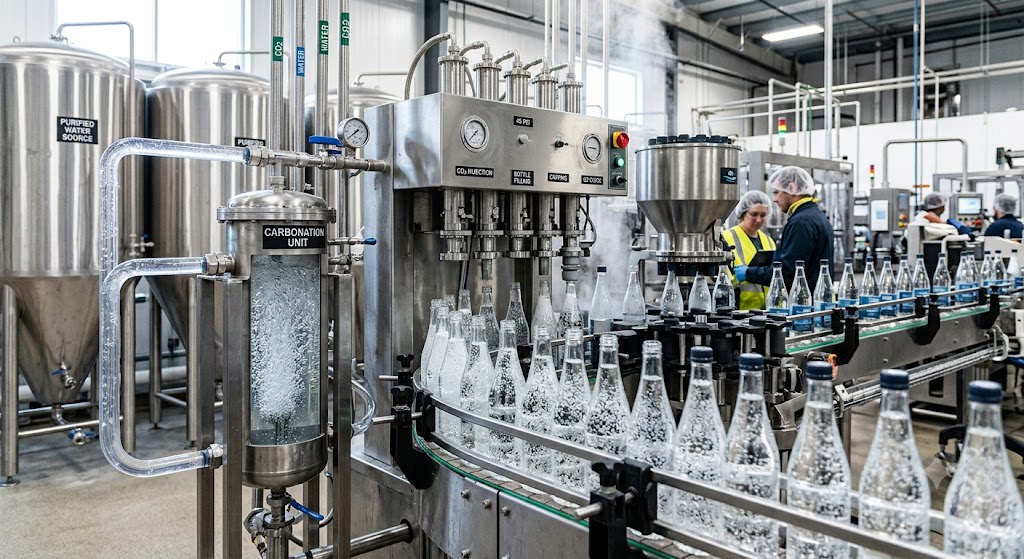
Commercial manufacturing facilities follow a highly controlled six-step process to produce sparkling water at scale.
Step 1: Sourcing and Filtration
The process begins with the base liquid. Seltzer brands like LaCroix, Bubly, and Waterloo start with municipal water that is run through a multi-stage filtration process, culminating in reverse osmosis (RO). RO filtration strips away all trace minerals, dissolved solids, chlorine, fluoride, and potential organic compounds, leaving a completely neutral, blank-canvas base.
Naturally sourced mineral waters—like Topo Chico, San Pellegrino, and Mountain Valley—bypass reverse osmosis. Instead, they are filtered to remove physical sediment while keeping their natural mineral profile intact.
Step 2: Chilling
The purified water is pumped into a cooling chamber and chilled to between 2°C and 4°C (35°F to 39°F). As established by Henry’s Law, this chilling step is mandatory to maximize the absorption rate of the carbon dioxide gas.
Step 3: Carbonation (CO2 Injection)
The chilled water enters a pressurized carbonation tank. Food-grade carbon dioxide gas ($CO_2$) is injected under pressure (typically around 30 to 35 PSI).
As the gas dissolves into the water, a small fraction reacts with the $H_2O$ to create carbonic acid ($H_2CO_3$). This weak acid gives sparkling water its slightly acidic pH (4.5 to 5.0) and its signature tangy, biting taste.
Note: Research published in The Journal of Neuroscience revealed that the “sting” of carbonation is not merely a tactile sensation of bubbles popping on your tongue. It is a chemical reaction—the carbonic acid stimulates sour-sensing nociceptors in your taste buds, sending a signal that your brain interprets as a crisp bite.
Step 4: Flavor Blending
For flavored sparkling waters, natural flavor essences (concentrated oils and aromatic compounds extracted from plants and fruits) are blended into the water. Because these essences are highly concentrated and contain no sugars, they blend smoothly into the carbonated base without disrupting the bubble structure.
For juice-based brands like Spindrift or the Topo Chico Sabores line, real fruit juice from concentrate or puree is added at this stage.
Step 5: Canning or Bottling
The carbonated water must be transferred into its final container without losing its fizz. To accomplish this, the filling machine operates in a pressurized environment. The empty cans or bottles are pressurized with gas before the liquid is injected.
Once filled, the container is immediately sealed with an aluminum pull-tab lid or a threaded plastic cap to maintain the internal pressure.
Step 6: Quality Control
Before shipping, batches are tested for:
- Carbonation Volume: Measured in “volumes of $CO_2$” (one volume is the amount of gas that would occupy the same space as the liquid at standard temperature). Most seltzers target 3.0 to 4.0 volumes.
- pH levels: Ensuring the acidity stays within target ranges.
- Microbial Safety: Continuous testing to guarantee zero bacterial growth.
Natural Carbonation vs. Forced Carbonation
While commercial seltzers use industrial $CO_2$ tanks (forced carbonation), some premium mineral waters boast natural carbonation.
In springs located near active or historical volcanic areas, underground thermal heat releases carbon dioxide from limestone deposits. This gas naturally dissolves into the groundwater under the immense pressure of the earth.
- Perrier: Sourced in France, the spring water and the natural gas rise together but are captured at different depths. The gas is filtered and reinjected back into the spring water during the bottling process to match the original spring’s ratios.
- Gerolsteiner: Sourced in Germany, the water emerges from volcanic geological layers so highly carbonated that it requires virtually no added gas to maintain its intense bubble structure.
How Home Carbonators (SodaStream) Work
Home systems like SodaStream or Aarke use the exact same principles of Henry’s Law, but scaled down for countertop convenience:
- Chilled Bottle: You fill a heavy-duty plastic or glass bottle with tap or filtered water (which you should always chill in the fridge first).
- Sealed Attachment: You screw or lock the bottle into the carbonation nozzle, forming a sealed, pressurized chamber.
- Manual Injection: Pressing the lever opens a valve on a pressurized $CO_2$ cylinder (typically containing 60L of compressed gas). This gas rushes into the water under pressure.
- Pressure Release: When you open the valve to detach the bottle, you hear a loud whistle. This is the machine venting excess gas to safely drop the pressure back to room level, locking the dissolved bubbles inside.
Because home machines operate with less mechanical pressure control than factory carbonators, home-carbonated water can sometimes feel like it goes flat faster. To get the best results at home: use ice-cold water, carbonate in 3 short bursts of 1–2 seconds, and ensure the bottle is locked tightly to maintain maximum pressure during injection.
🫧 Carbonation PSI Guide
Select a water temperature to see the required carbonation pressure (PSI) and how it affects bubble feel!
Frequently Asked Questions
How is sparkling water made?
Sparkling water is made by dissolving carbon dioxide gas into still water under high pressure. The CO2 remains dissolved as long as the container is sealed and under pressure. When you open it, the pressure drops and the CO2 escapes as bubbles.
How is carbonated water made?
The same process as sparkling water. CO2 gas is injected into chilled water under pressure. The gas dissolves to form a small amount of carbonic acid, which gives the water its fizzy character and slightly tart taste.
What makes sparkling water sparkling?
The dissolved CO2. Under pressure, CO2 stays dissolved in the water. When you open the container, the pressure releases and the CO2 escapes as the fizz and bubbles you see and feel.
How is seltzer water made?
The same process. Seltzer is plain purified water with CO2 added under pressure. No minerals, no flavoring, no sweeteners. The purest form of carbonated water.
What is the carbonation process for water?
Water is first filtered and chilled. Food-grade CO2 is then injected under pressure (typically 25 to 40 PSI for commercial production). The CO2 dissolves into the water, forming carbonic acid. The water is sealed to maintain pressure and bottled for distribution.
What is CO2 in sparkling water?
Carbon dioxide, a colorless and odorless gas naturally present in the atmosphere. In sparkling water, it is dissolved under pressure and forms carbonic acid when it reacts with water molecules. The carbonic acid is a weak acid responsible for the tangy taste of sparkling water and its slightly acidic pH (around 4.5 to 5).
How does SodaStream carbonate water?
A pressurized CO2 cartridge is connected to the machine. Cold water in a special bottle is attached, and pressing a button releases CO2 into the sealed bottle. The gas dissolves into the cold water. The same principle as commercial carbonation, but at smaller scale and lower pressure precision.
Who invented sparkling water?
Joseph Priestley first produced artificially carbonated water in 1767. Johann Jacob Schweppe commercialized the process in the 1780s, founding what eventually became the Schweppes brand.
References
- ScienceInsights. “How Is Sparkling Water Made? The Science Explained.” scienceinsights.org. March 2026.
- ScienceInsights. “What Makes Carbonation in Soda? CO2 Explained.” scienceinsights.org. March 2026.
- The Conversation. “The Bubbly Chemistry Behind Carbonated Beverages.” theconversation.com. 2024.
- SodaStream. “How Is Water Carbonated?” sodastream.com. 2024.
- SodaStream Canada. “How Is Water Carbonated?” sodastream.ca.
- Soda Sense. “What Is a Carbonator?” sodasense.com. October 2025.
- Quantiperm. “How Carbonated Drinks Are Made.” quantiperm.com. 2024.
- Journal of Neuroscience. Referenced in ScienceInsights (CO2 and tongue cell pH drop).
- William Henry, “Experiments on the Quantity of Gases Absorbed by Water,” Philosophical Transactions of the Royal Society of London, 1803.