
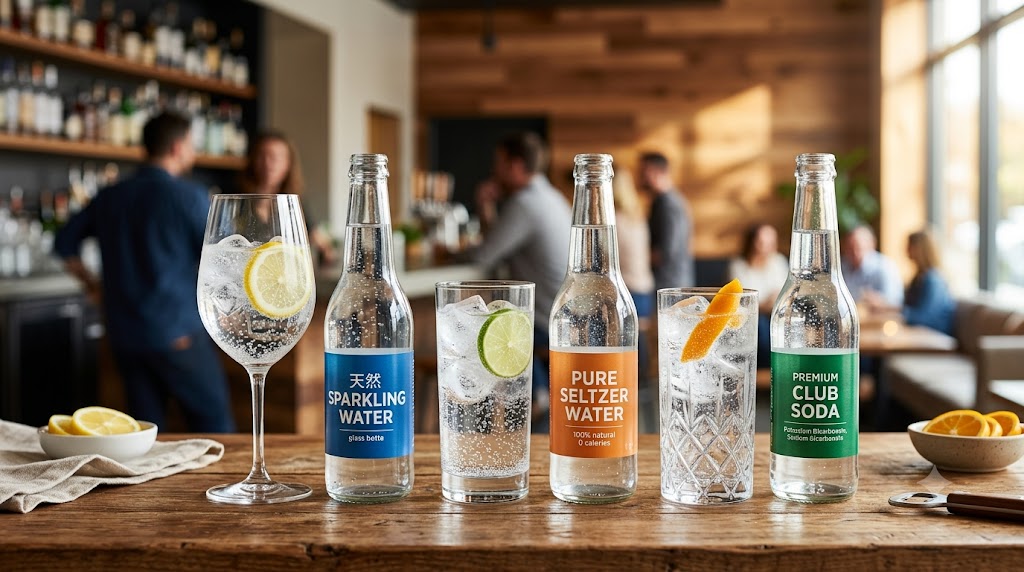
You are standing at a bar and the server asks: “Still or sparkling?” Easy decision. But then you go home to make a cocktail and suddenly you are staring at a supermarket shelf stacked with seltzer, club soda, tonic water, and three different kinds of sparkling mineral water. All of them are fizzy, and none of them look obviously different to the eye.
This confusion happens because the carbonated water category has grown a lot faster than the vocabulary around it. Most people use “sparkling water” and “seltzer” interchangeably. Bartenders reach for club soda in cocktail builds without explaining the science behind the choice. And tonic water sits on the exact same shelf, even though it is physically a completely different beverage.
Here is the full breakdown, clearly explained, so you know exactly what is in your glass.
The Four Categories Compared
| Type | Base Water | Minerals / Additives | Sodium | Calories | Best Use |
|---|---|---|---|---|---|
| Seltzer | Purified Water | None | 0 mg | 0 | Everyday hydration, light fruit mocktails |
| Club Soda | Purified Water | Added mineral salts (e.g. sodium bicarbonate) | 50 to 95 mg | 0 | Cocktails (Highballs, Spritzes) |
| Sparkling Mineral Water | Natural Spring | Naturally occurring (calcium, magnesium) | Varies by source | 0 | Dining, table water, mineral support |
| Tonic Water | Purified Water | Quinine + Sugar or corn syrup | Low | 80 to 130 | Gin and Tonic, bitter mixers |
What Is Seltzer Water?
Seltzer is the simplest and cleanest of the four categories. It is purified municipal water with carbon dioxide (CO2) forced in under pressure. There are no added minerals, no sodium, and no sweeteners. The result is a highly neutral, clean, and refreshing fizzy water with a slightly tart edge. This tartness comes from the carbonic acid that forms naturally when CO2 gas dissolves in water.
The term “seltzer” originates from Selters, a German town famous since the 18th century for its natural sparkling mineral springs. Settlers and manufacturers eventually learned to replicate this fizz in purified water, and the name stuck long after production shifted away from natural springs.
What you are buying when you pick up mainstream seltzers like LaCroix Pure, Bubly, or Waterloo is this neutral carbonated water base. The plant-derived natural flavor essences are simply layered on top of this clean canvas.
- Sodium: 0 mg
- Calories: 0
- Sweeteners: None
What Is Club Soda?
Club soda starts out the exact same way as seltzer—purified carbonated water—but the manufacturer adds mineral salts back into the water during production. These typically include potassium sulfate, sodium chloride, disodium phosphate, and sodium bicarbonate (baking soda).
These added minerals serve two practical purposes:
- They replicate the slightly savory, earthy flavor profile of natural mineral spring waters.
- They create a firmer, crisper, and more stable bubble structure that holds its carbonation longer.
As noted by VinePair, club soda has a “slightly salty, mineral taste that enhances and balances the flavor of mixed spirits.” This makes it the absolute preferred choice for classic cocktails like a Whiskey Highball, Tom Collins, or a Campari Spritz. The minerals help cut through the high alcohol content and balance the drink’s sweetness.
- Sodium: 50 to 95 mg per 12 oz (varies by brand)
- Calories: 0
- Sweeteners: None
What Is Sparkling Mineral Water?
Sparkling mineral water is the only category in this group where the word “natural” is regulated by strict standards. According to the FDA, water labeled as “mineral water” must originate from an underground spring that is naturally protected. It must naturally contain at least 250 parts per million (ppm) of Total Dissolved Solids (TDS) at the point of bottling. No minerals can be added to the water later.
This is the key distinction. Sparkling mineral waters carry the geological signature of the ground they filter through:
- San Pellegrino: Drawn from the Italian Alps, it contains naturally occurring calcium (203 mg/L) and magnesium (56 mg/L).
- Gerolsteiner: Sourced from volcanic aquifers in Germany, it contains an exceptionally high mineral count (348 mg/L calcium and 108 mg/L magnesium).
- Topo Chico: Draw from a spring in Monterrey, Mexico, famous for its natural mineral character and intense bubble structure.
The carbonation in mineral waters can be naturally occurring from the source, or added during bottling to make the fizz consistent. Because of the natural minerals, these waters have a distinct, slightly savory, or thick mouthfeel. They are best enjoyed straight or served at the dinner table.
What Is Tonic Water?
Tonic water is the outlier of the carbonated water family. While it starts as carbonated purified water, it contains two major additions: quinine and sugar (either cane sugar or high-fructose corn syrup).
Quinine is a naturally occurring crystalline alkaloid derived from the bark of the cinchona tree, historically used in South America and India to treat malaria. In modern tonic water, the quinine level is low and is added solely for its distinct, dry bitterness. To balance this intense bitterness, manufacturers add sugar, bringing the calorie count of tonic water to 80 to 130 calories per 12oz can—making it equivalent to a standard soft drink.
Tonic water is not a health drink and should not be used for daily hydration. Its primary role is as a cocktail mixer, most famously in the classic Gin and Tonic. The drink was popularized by British soldiers in colonial India in the 19th century, who mixed their daily bitter quinine malaria ration with gin, water, and sugar to make it drinkable.
Substituting tonic water for seltzer or club soda in a recipe is a massive mistake. It will completely alter the flavor profile by adding calories, sweetness, and a sharp bitterness.
Which Carbonated Water Should You Mix in Cocktails?
Choosing the right bubble style is a critical cocktail decision:
- Club Soda: Choose this for simple, spirit-forward drinks like highballs, ranch water, or spritzes. The mineral salts provide a textural backbone that supports the spirit and prevents the carbonation from tasting “hollow.”
- Seltzer: Choose this for drinks where you are adding your own complex syrups, fruit juices, or fresh herbs (like a mojito or a mocktail). Seltzer’s absolute neutrality ensures that your fresh ingredients remain the star of the show.
- Sparkling Mineral Water: Excellent for drinking straight alongside food. The mineral notes help cleanse the palate between rich bites.
- Tonic Water: Reserved strictly for drinks designed around its bitter-sweet profile, like a Gin and Tonic or a Vodka Tonic.
🍹 Cocktail Fizz Matcher
Answer 2 quick questions to find the perfect carbonation for your glass!
1. What kind of drink are you making?
Frequently Asked Questions
What is the difference between sparkling water and club soda and seltzer?
Seltzer is plain purified water with added CO2 and nothing else. Club soda is purified water with CO2 and added mineral salts. Sparkling water (or sparkling mineral water) comes from a natural spring with minerals already present. All three are zero-calorie and zero-sugar. Tonic water is the one that contains sugar and quinine.
Is club soda the same as sparkling water?
No. Club soda is artificially carbonated purified water with added minerals. Sparkling mineral water comes from a natural spring with naturally occurring minerals. They may taste similar but the source and mineral profile are different.
Which is healthier: seltzer or sparkling water?
Both are healthy with zero calories and zero sugar. Sparkling mineral water has the advantage of natural calcium, magnesium, and potassium from the source, which can contribute meaningfully to daily mineral intake. Seltzer has nothing extra, which is also fine.
Does club soda taste like seltzer?
Close but not identical. Club soda has a slightly salty, savory note from the added minerals. Seltzer is more neutral and clean. Most people can tell the difference in a side-by-side comparison, though the gap is subtle.
Is mineral water the same as sparkling water?
Not necessarily. 'Sparkling water' is a broad category that includes seltzer (plain carbonated water) and mineral water (spring-sourced). 'Mineral water' specifically refers to water from an underground source with at least 250 ppm Total Dissolved Solids, per the FDA. Not all sparkling water is mineral water.
Which has more carbonation: club soda or seltzer?
They are typically similar in carbonation intensity. Some club soda brands are slightly more carbonated than standard seltzer because the mineral salts support bubble formation. Mineral waters like Topo Chico have among the highest natural carbonation levels.
Can you substitute club soda for seltzer?
For most casual drinking purposes, yes. For precise cocktail mixing, the added minerals in club soda change the flavor profile of simple two-ingredient drinks. In a Whiskey Highball, for example, the choice between club soda and seltzer is a real flavor decision.
What is the difference between soda water and sparkling water?
'Soda water' is typically used interchangeably with seltzer or club soda depending on the context. 'Sparkling water' technically refers to naturally carbonated mineral water in the most precise usage, though in everyday American English both terms get used loosely.
Which is better for mixing drinks: club soda or seltzer?
Club soda is the traditional cocktail choice because its mineral salts add texture and balance to spirit-forward drinks. Seltzer is preferable when you want maximum neutrality and the other ingredients to come through cleanly.
Is carbonated water just soda?
No. Carbonated water (seltzer, sparkling water, mineral water) contains no sugar, no sweeteners, no flavoring beyond natural essences, and zero calories. Soda (Coca-Cola, Pepsi, Dr Pepper) contains sugar, flavoring, and 39 to 46g of sugar per 12oz.
References
- VinePair. “What’s the Difference Between Club Soda, Seltzer, and Sparkling Water?” vinepair.com. 2023.
- Healthline. “Club Soda vs. Seltzer, Mineral and Tonic Water.” healthline.com. Updated 2026.
- Ingredi. “What’s the Difference Between Seltzer, Sparkling Water, Club Soda, and Tonic Water?” ingredi.com.
- Frizzlife. “Club Soda vs Seltzer, Tonic and Sparkling Water.” frizzlife.com. 2025.
- Soda Sense. “What’s the Difference Between Soda Water vs. Club Soda vs. Sparkling Water vs. Tonic Water?” sodasense.com. 2025.
- FDA. “Bottled Water Regulation and the FDA.” fda.gov.
- Centers for Disease Control and Prevention, “Get the Facts: Sugar-Sweetened Beverages,” cdc.gov.